
Case study — Multi-Tool Platform · Programmatic SEO
OnlineToolPot
OnlineToolPot is a scalable multi-tool web platform — text tools, file converters, calculators and AI-powered utilities — built with Next.js, React and TypeScript. I designed the programmatic SEO architecture behind 130+ tool pages, implemented ISR with revalidation APIs so admin updates go live instantly, and raised the mobile PageSpeed score from around 55 to around 90.
- Role
- Full Stack Developer
- Services
- Web Application · Programmatic SEO · Performance
- Stack
- Next.js · React · TypeScript · Tailwind CSS · Redux · React Query
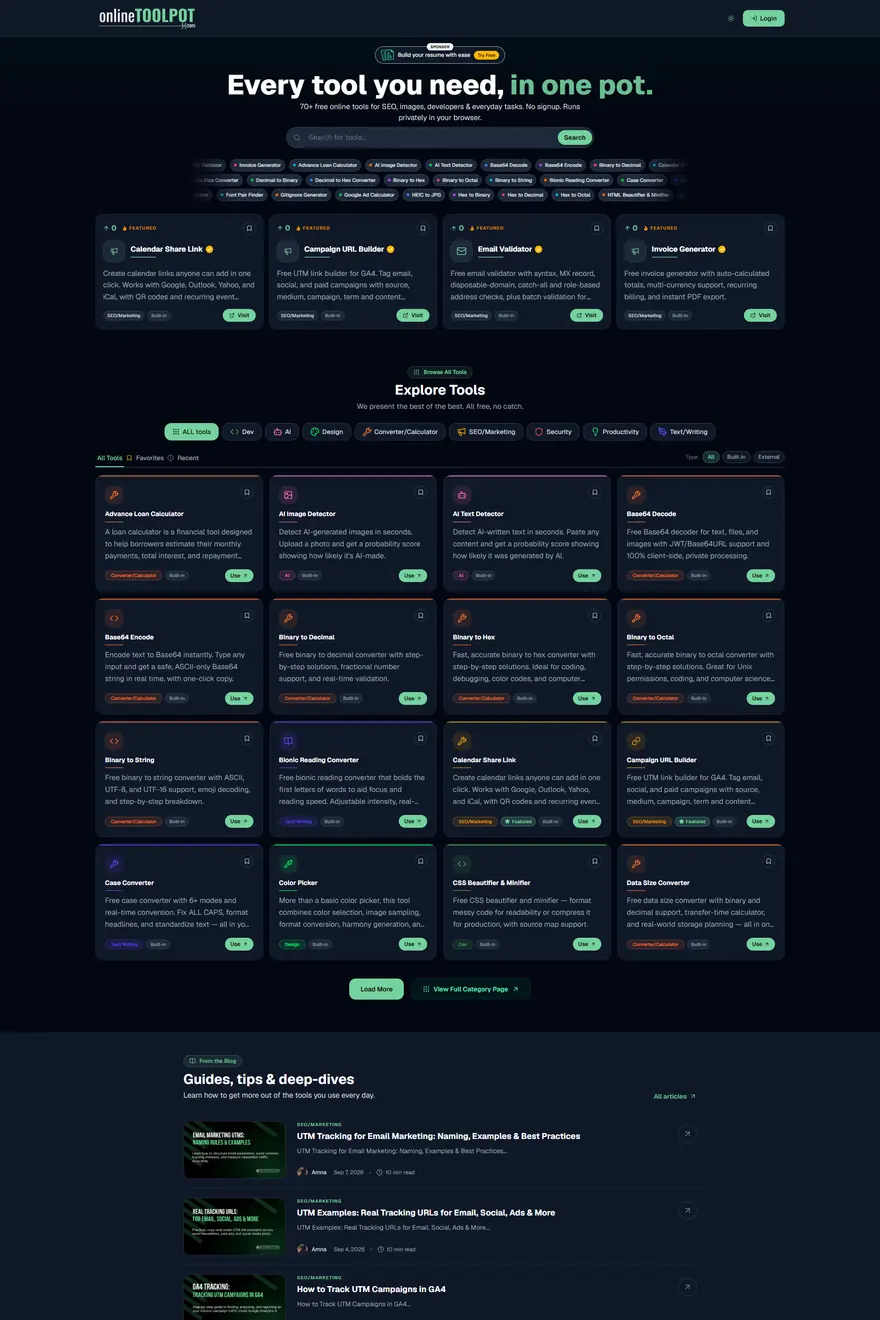
Live build — hover to pan
01
The Challenge
A tool platform lives on organic search. Each of the 130+ tools needs its own page that ranks for its own query, and every one of those pages has to load fast on a phone, because that is where most tool searches happen.
The starting point had two problems. Tool pages were not structured for search at scale, and the mobile PageSpeed score sat around 55 — duplicate icon libraries, eager-loaded components and unoptimized fonts were dragging every page down.
02
The Strategy
I treated the catalogue as a programmatic SEO system rather than a set of hand-built pages. One template, driven by structured tool data, generates a complete page for every tool: title, description, canonical tag, structured data, related tools and content sections.
Performance was tackled as an engineering task with a measurable target. Every fix — dependency cleanup, lazy loading, font optimization — was checked against PageSpeed Insights so the score reflected real improvements, not guesses.
03
The Design
Tool pages follow a consistent layout: the tool itself above the fold, a clear explanation beneath it, and related tools and guides after that. Users get to the tool instantly; search engines get a complete, well-structured page.
The homepage acts as a discovery surface — search, categories and featured tools — with Tailwind CSS keeping the visual system consistent across dozens of tool types.
04
The Development
The platform is Next.js and React in TypeScript, with Redux for shared state and React Query for data fetching and caching. Tool pages are generated with ISR from structured data, and revalidation APIs let the admin dashboard update any page on the live site without a rebuild.
Performance work included removing duplicate icon-library loading, lazy-loading heavier components with next/dynamic, and optimizing font loading — the changes that moved mobile PageSpeed from ~55 to ~90.
05
The SEO
Every tool page ships with dynamic metadata, canonical tags, structured data and internal links to related tools, and the XML sitemap is generated from the same data. That is what makes 130+ pages crawlable and distinct rather than duplicates of each other.
Because pages are pre-rendered and revalidated on demand, search engines always receive fast, complete HTML — the foundation programmatic SEO depends on.
06
The Performance
The mobile PageSpeed score improved from around 55 to around 90 through dependency cleanup, lazy-loaded components and font optimization, with Core Web Vitals — LCP, CLS and TTFB — tracked throughout.
ISR keeps time to first byte low across the whole catalogue, and React Query caching keeps in-app interactions responsive.
07
The Result
OnlineToolPot runs as a single, scalable system: one template and one data model produce 130+ optimized tool pages, admin updates appear instantly, and the platform loads fast on mobile.
Programmatic SEO with ISR is the approach I recommend for any catalogue-style product — it compounds as the catalogue grows instead of fragmenting.
Services behind this project
Next Step
Have an idea for a website?
Let's turn it into something people remember — and search engines can understand.
Usually replies within a day · Lahore, Pakistan · working worldwide
View my work