
Case study — AI Career Tools · SaaS
Resumaic
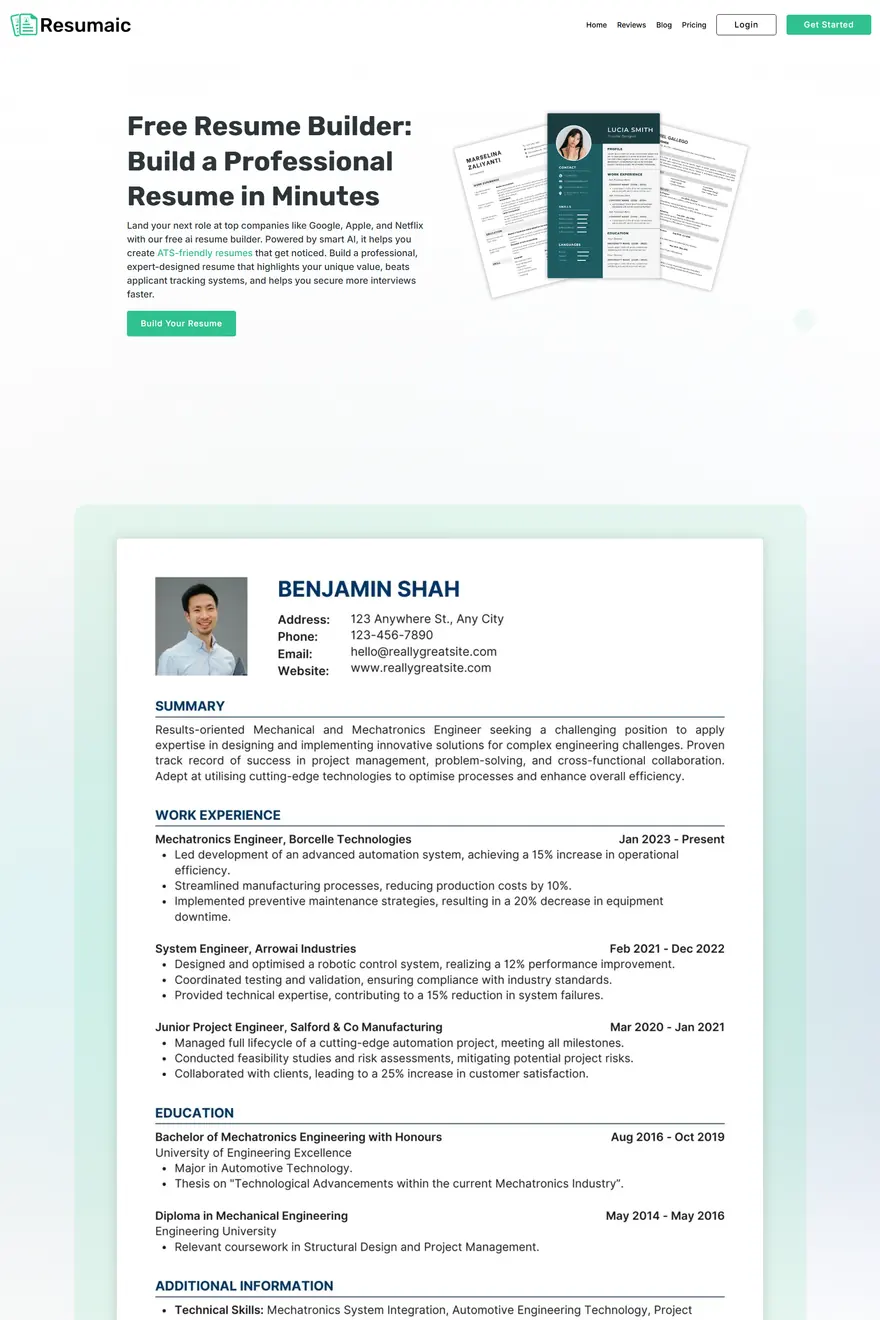
Resumaic is a full-stack SaaS platform for AI-powered resume creation, cover letter generation and ATS compatibility analysis. I built the product end to end: a React and Next.js frontend in TypeScript and Tailwind CSS, a Laravel backend with a Node.js microservice for ATS scoring and resume parsing, Stripe subscription billing, Google OAuth, and ISR with on-demand revalidation so content edited in the admin dashboard goes live instantly.
- Role
- Full Stack Developer
- Services
- SaaS Platform · AI Features · Stripe Billing · ISR & SEO
- Stack
- Next.js · React · TypeScript · Tailwind CSS · Laravel · Node.js · Stripe
Live build — hover to pan
01
The Challenge
A resume builder competes on two fronts at once. The product has to feel fast and reliable while it generates, scores and exports documents, and the marketing side has to rank for the searches job seekers actually make. Both sides live on the same domain, so a slow page or a rebuild that takes minutes hurts the business twice.
The technical brief was demanding for a small team: AI generation for resumes and cover letters, an ATS scoring engine that parses uploaded resumes, subscription billing, social login, and an admin dashboard whose changes should appear on the live site without waiting for a deployment.
02
The Strategy
I split the system by responsibility. The Next.js frontend owns the experience and the SEO surface, the Laravel API owns accounts, billing and content, and a dedicated Node.js microservice owns the heavy parsing and ATS scoring so it can scale and fail independently of the main app.
For content, I chose Incremental Static Regeneration with on-demand revalidation. Public pages are served as static HTML for speed and crawlability, and a revalidation API lets the dashboard purge exactly the pages that changed — no full rebuilds, no stale content.
03
The Design
The interface follows the same rule as the resumes it produces: clear hierarchy, generous spacing and nothing competing with the primary action. The builder is a focused, step-based flow with live preview, so users always see what the AI is producing.
Marketing pages were designed around search intent — a strong headline, a direct explanation of what the tool does, and immediate access to the builder. Tailwind CSS kept the design system consistent between the product and the public site.
04
The Development
The frontend is React and Next.js in TypeScript, with Redux for application state and React Query for server state, caching and background refetching. Tailwind CSS drives the UI. Authentication uses Google OAuth alongside email accounts, and Stripe handles subscription plans, checkout and webhooks.
The Laravel backend exposes a REST API for users, documents, plans and CMS content. The Node.js microservice parses uploaded resumes and computes ATS compatibility scores, called from the API so the frontend never talks to it directly. The frontend deploys to Vercel.
05
The SEO
Every public page ships with dynamic metadata, canonical tags and structured data generated from the CMS, plus an XML sitemap that updates as content is added. Blog and landing pages are pre-rendered through ISR so search engines receive complete HTML.
On-demand revalidation was the key SEO win: editors can fix a title or publish an article and the live page updates within seconds, so the site never serves outdated content to crawlers or users.
06
The Performance
Static generation with ISR gives near-instant first loads on public pages. Inside the app, React Query caching and lazy-loaded components keep interactions responsive while the AI and scoring calls run in the background.
Heavy work — parsing, scoring, document generation — runs server-side in the microservice, keeping the client bundle lean and Core Web Vitals healthy on mobile.
07
The Result
Resumaic launched as a complete SaaS: AI resume and cover letter generation, ATS scoring, subscription billing and an admin dashboard whose changes reflect on the live site instantly. The architecture separates concerns cleanly enough that each part can evolve on its own.
The same patterns — ISR with on-demand revalidation, a typed React frontend, a REST backend and isolated services for heavy work — are what I bring to every SaaS build.
Services behind this project
Next Step
Have an idea for a website?
Let's turn it into something people remember — and search engines can understand.
Usually replies within a day · Lahore, Pakistan · working worldwide
View my work